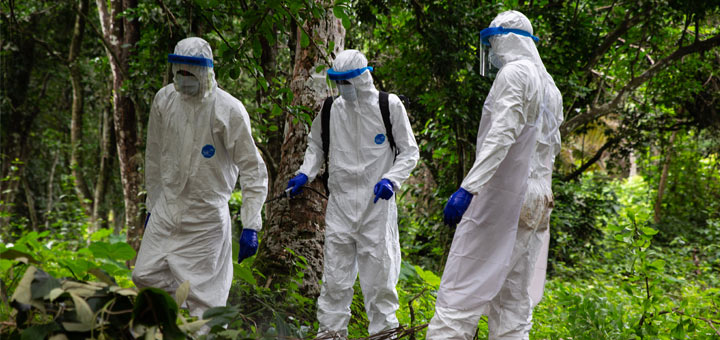
The World Health Organization (WHO) declared that the current Ebola outbreak in Central Africa is a public health emergency. The count of suspected cases continues to rise, and health officials are racing to trace contacts. Cases were confirmed in the Democratic Republic of Congo (DRC) and Uganda as of May 17th, 2026. Although the global risk remains low, the WHO called the outbreak a matter of “international concern.” As a result, the United States issued travel restrictions for certain travelers coming from the DRC, Uganda, and South Sudan.
James Baguma, a public health researcher, was not surprised by the recent Ebola outbreak in the DRC. He has studied interactions between wildlife and people in Uganda’s Bundibugyo district, where the species of Ebola virus behind the outbreak was first identified nearly two decades ago. The most recent outbreak is the 17th Ebola outbreak in the DRC since the virus was first identified in 1976.
Currently, 51 people have tested positive for the Bundibugyo species, although another 600 people have suspected infections. Health experts believe 139 are thought to have died from the disease, and cases are expected to rise. Keep in mind that this is an evolving health emergency, so the numbers are only related to this point in time. What was the origin of this latest outbreak? Researchers suspect fruit bats, but this is just a theory.
Why Is This Region So At Risk For Ebola Outbreaks?
People in Bundibugyo reside close to national parks, which have a high number of fruit bats and other primates, such as monkeys and baboons. These animals interact with the surrounding communities. Additionally, people go to those national parks to hunt, while the animals from the parks go to people’s gardens to gather food. Physical contact with wildlife is common, and some people may eat those creatures. Because the ecosystem is so interwoven, the possibility of a spillover through direct contact is higher.
The current outbreak is taking place in Uganda’s border with the DRC, and people can move in and out freely in that area, often without passports or other forms of identification. Bushmeat markets exist between the DRC and Uganda. People sell the meat of baboons, monkeys, and bats in these markets. People state that they eat all of that meat and do not get sick, but that makes it harder to detect sustained behavior change. Most experts believe that that is how outbreaks begin.
Having bats inside the home is another risk of Ebola contraction. Bats can easily contaminate food and water without people noticing. Their droppings and urine accumulate in floors and such, and people might drop food, pick it up, and then eat it without washing it. Children can also pick up fruits from gardens that were partially eaten by bats, which increases the risk of infection.
How Is Ebola Transmitted?
WHO officials believe that transmission of the current outbreak could have been going on for months before it was detected. A weak health infrastructure in the rural area where the virus originated combined with ethnic conflict and the unusual strain impaired testing. U.S. foreign aid funding cuts could have also contributed, according to aid workers.
Once the virus enters a community, it quickly spreads between people through direct contact with bodily fluids or contaminated surfaces. Scientists believe that humans first contracted Ebola via hunting, handling, or eating infected wild animals. Risk of transmission also stems from local funeral customs, which involve mourners touching the deceased, and that can lead to infection.
Ultimately, the goal is to increase awareness about these diseases, but there are other problems people have to worry about in their daily lives. When there isn’t an active outbreak, people focus on immediate needs, such as income and food. Don’t let misinformation about the illness spread, because it can undermine local containment efforts. As a reminder, this situation is evolving and this is the information we have as of now.

Vincent Stevens is the senior content writer at Dherbs. As a fitness and health and wellness enthusiast, he enjoys covering a variety of topics, including the latest health, fitness, beauty, and lifestyle trends. His goal is to inform people of different ways they can improve their overall health, which aligns with Dherbs’ core values. He received his bachelor’s degree in creative writing from the University of Redlands, graduating summa cum laude. He lives in Los Angeles, CA.